SMS24.me guide
What Is an SMSC? How the SMS Message Center Works
Understand the SMS message center, store-and-forward delivery, and why changing an SMSC number is not a universal fix for missing texts.
By SMS24 Editorial Team | Published September 5, 2026
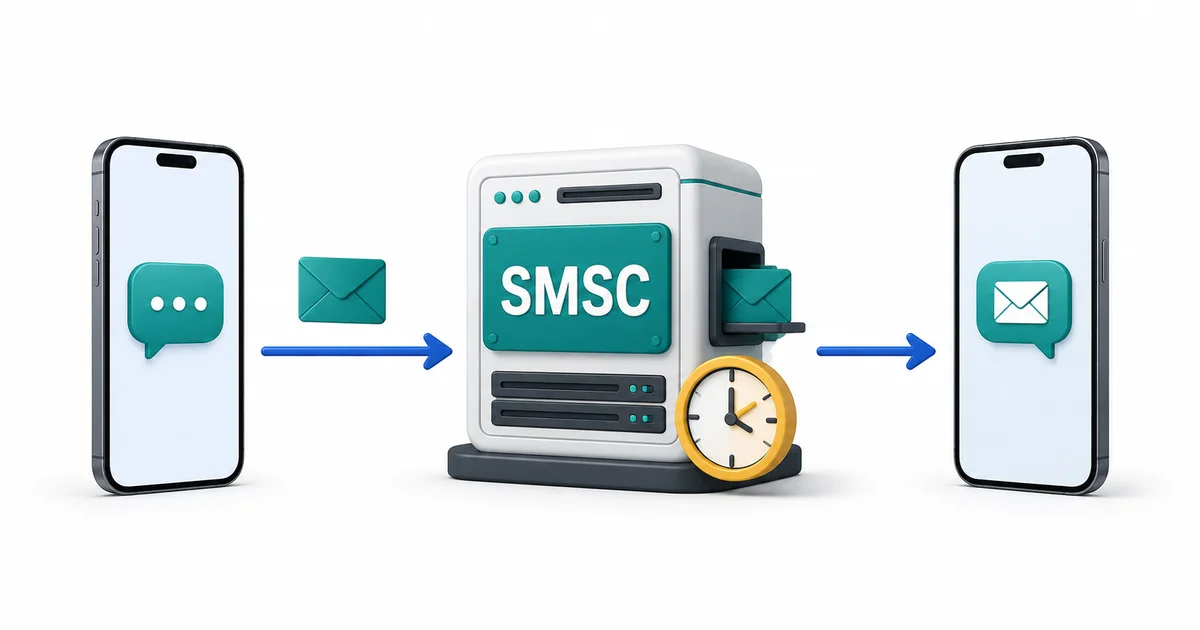
SMSC stands for Short Message Service Center. It is a network system that handles SMS messages between a sender and a recipient. A useful way to understand it is as a message-sorting service: it accepts a text, works out where it needs to go, and may hold it temporarily when immediate delivery is not possible.
If you found an SMSC number in your phone settings, that number relates to your mobile operator. It is not the number of the person you are texting, and it is not the name shown above an incoming message. You normally do not need to change it to receive a verification code.
What does an SMSC do?
An SMS message does not always travel directly from one handset to another. Network infrastructure handles submission and delivery. The SMSC is part of that infrastructure, responsible for receiving and forwarding messages and, in common configurations, storing them while delivery is pending.
For example, imagine sending a text to a phone that is switched off. A store-and-forward system can retain the message and attempt delivery later. Delivery is still subject to the applicable validity period and network conditions; temporary storage is not a promise that every message will eventually arrive. Sinch explains the SMSC role using this store-and-forward model.
How a text message passes through the network
The following is a simplified description rather than a diagram of every carrier component. Actual routes differ between networks and between texts sent by people and messages sent by applications.
- Submission: a phone or messaging application submits a text with a destination address.
- Network handling: messaging systems accept the request and route it toward the destination network.
- Delivery attempt: the receiving side attempts to deliver the SMS. If the destination is temporarily unavailable, storage and retry may apply.
- Outcome: the route may report delivery, an error, or expiry. The detail visible to the sender depends on the service.
For application messaging, software may connect through a provider API or protocols such as SMPP. Infobip describes SMPP as a protocol for exchanging messages between SMS applications and message centers. The business application and the SMSC therefore have different roles, even when a provider manages both parts of the service.
What is an SMSC number?
An SMSC number is an operator-provided service-center address used in SMS configuration. On some phones it appears under a setting named Message center or Service center. Whether the setting is visible or editable depends on the device, messaging application, and carrier configuration.
There is no single SMSC number that works for every network. Your correct setting comes from your operator, not from the country code of the person you are messaging. A number copied from a different carrier or an old support discussion may be unsuitable for your SIM.
If ordinary outgoing SMS fails, an incorrect setting is one possible cause. Samsung recommends checking with the network operator when the stored message-center number is missing or wrong. Confirm the appropriate value and instructions with your carrier before editing it.
SMSC vs. Sender ID vs. destination number
These terms describe different parts of an SMS:
- SMSC: the network system handling message delivery.
- SMSC number: the service-center address associated with operator configuration.
- Sender ID: the name, short code, or number displayed as the source of an incoming text.
- Destination number: the phone number to which the message is addressed.
A company name at the top of a text conversation is not your SMS message center. Changing a service-center setting will not turn that label into a different sender. Our SMS Sender ID guide explains why some incoming texts display names while others display numbers.
Does a sent message mean the SMSC delivered it?
A sent label and a delivered label should not be treated as interchangeable. The exact meaning depends on the application and route. A message can be submitted successfully before the destination receives it, and successful delivery does not establish that the recipient read it.
This distinction matters when troubleshooting. Write down the actual status and time instead of assuming that an unanswered message failed. Read our explanation of sent, delivered, and read statuses for the user-facing differences.
Why can an SMS or verification code arrive late?
The SMSC is only one part of the path. An application may delay creating a message, a provider may queue it, a carrier may filter it, or a destination may be temporarily unreachable. A user can observe the delay without knowing which stage caused it.
Verification codes also have an expiry rule set by the service that issued them. A message arriving later does not extend the life of the code inside it. Requesting several codes can create confusion if an older message arrives after a newer request.
Check the destination number, allow the stated waiting period, and follow the service resend instructions. If only one service fails while other SMS messages arrive, changing the phone SMSC setting is not a sensible first assumption. Use the verification-code troubleshooting checklist to narrow down the problem.
Public SMS inboxes and message-center settings
A web-based public inbox is not the same as the SMS application on your own phone. Editing a setting on your handset does not configure the remote number whose inbox you are viewing. The site interface may show a received message without exposing its full carrier route.
For a permitted, non-sensitive delivery test, you can browse available temporary phone numbers and open the matching public inbox. Public messages can be read by other visitors. Use a private number you control for personal accounts, banking, password recovery, and ongoing authentication.
Common SMSC questions
Is SMSC the same as SMS?
No. SMS is the messaging service; SMSC is a network system involved in handling its messages.
Is there a universal SMS message center number?
No. Obtain the correct configuration from the operator responsible for your SIM. A generic list cannot establish which setting applies to your subscription.
Should I change the SMSC number for a missing OTP?
Do not change it just because one incoming code is missing. First check the destination and the issuing service. Ask your operator to investigate configuration if ordinary SMS sending is also affected.
Does an SMSC guarantee instant delivery?
No. Message handling still depends on the route, destination availability, and applicable delivery rules. Temporary storage and retries have limits.